Tile Tango: The Fast-Moving Pattern Game We Keep Playing
Disclosure: This post contains affiliate links, which means I may earn a commission if you make a purchase through one of my links, at no additional cost to you. As an Amazon Associate, I earn from qualifying purchases. Please see our full disclosure for more information. The Art Kit participates in the Target Affiliate Marketing Program and Walmart’s affiliate program and may earn commissions from qualifying purchases made through our links. Please note: Always use appropriate supervision and use caution with small pieces. Be sure products and activities are appropriate for your child’s age and skill level.
Some games take longer to explain than they do to play. Tile Tango is not one of them.
Flip a card, copy the pattern, and be the first player to slap the card. That is the basic idea—but once everyone starts flipping and shifting tiles at the same time, the table gets lively very quickly!
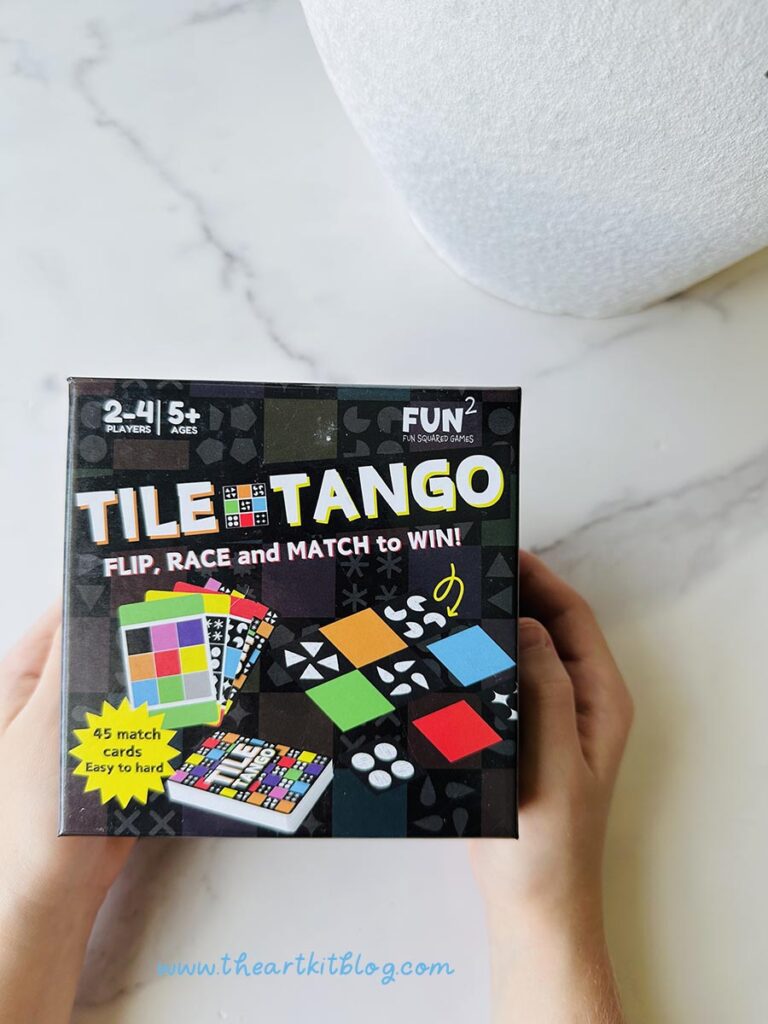
Tile Tango from Fun Squared Games is a colorful, hands-on pattern matching game designed for ages five and up. It combines speed, visual attention, and spatial reasoning in short rounds that are easy to fit into family game night, a homeschool break, or a rainy afternoon.
If you have been wondering whether Tile Tango is worth adding to your game shelf, here is a closer look at how it works, what makes it different, and who will probably enjoy it most.
Check the current price of the Tile Tango Matching Game here.
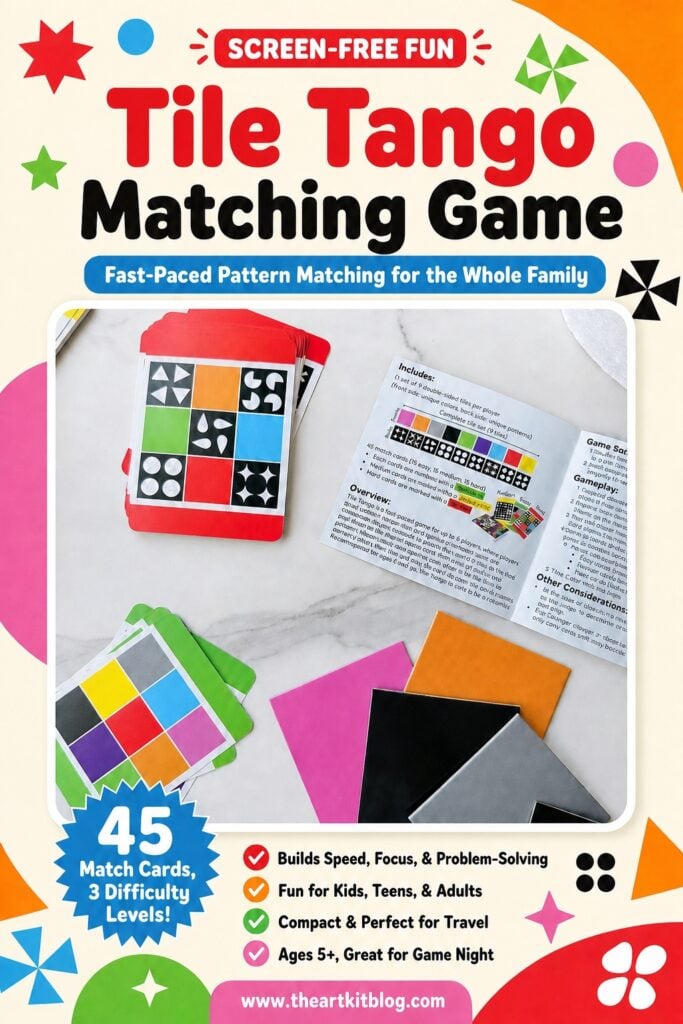
Tile Tango at a Glance
- Recommended age: 5 and up
- Number of players: 2–4
- Type of game: Pattern matching, speed, and visual-spatial play
- Number of match cards: 45
- Difficulty levels: Easy, medium, and hard
- Skills practiced: Pattern recognition, spatial reasoning, focus, visual scanning, and flexible thinking
- Packaged size: 4.25 × 4.25 × 3.08 inches
What Is the Tile Tango Game?
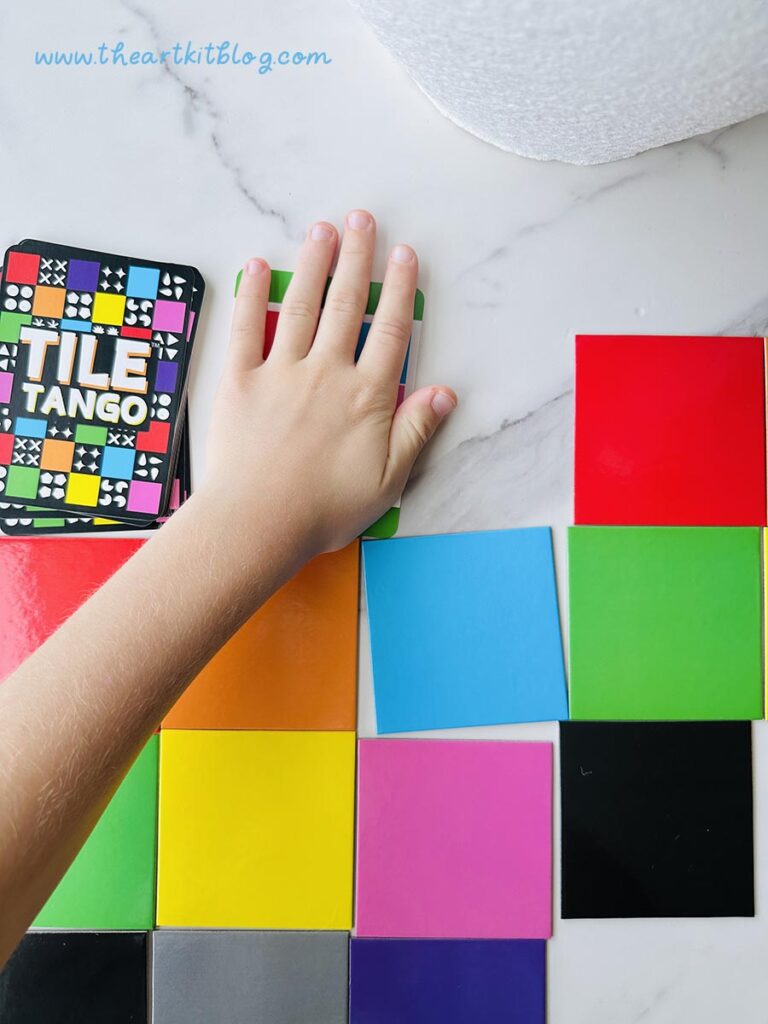
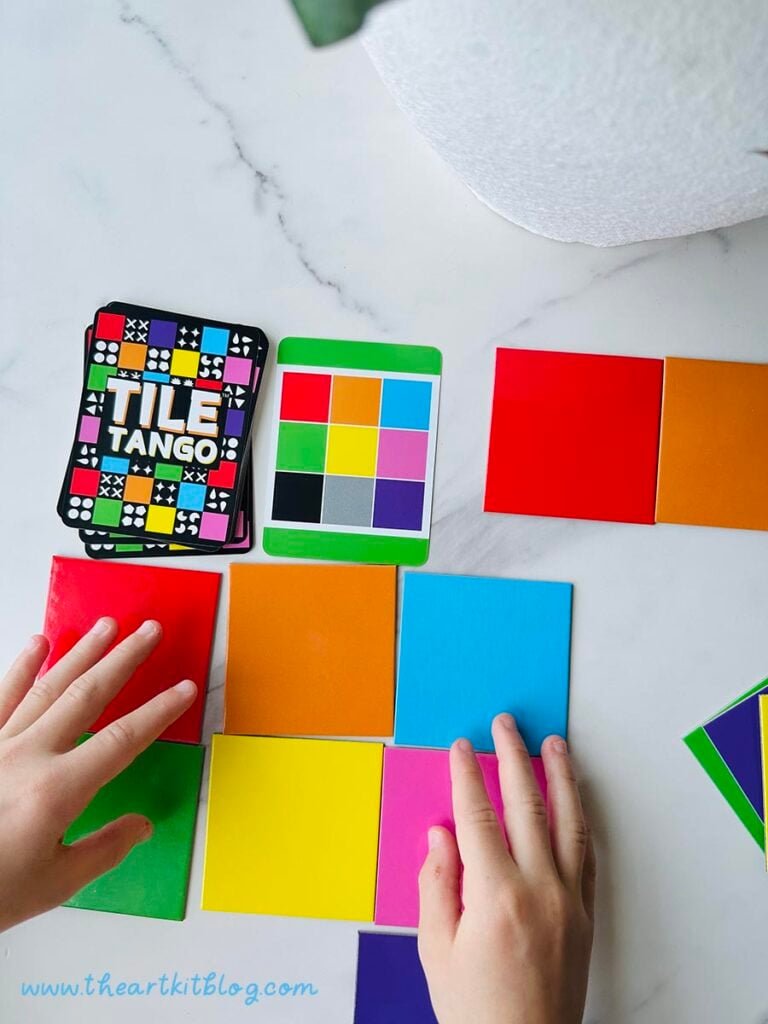
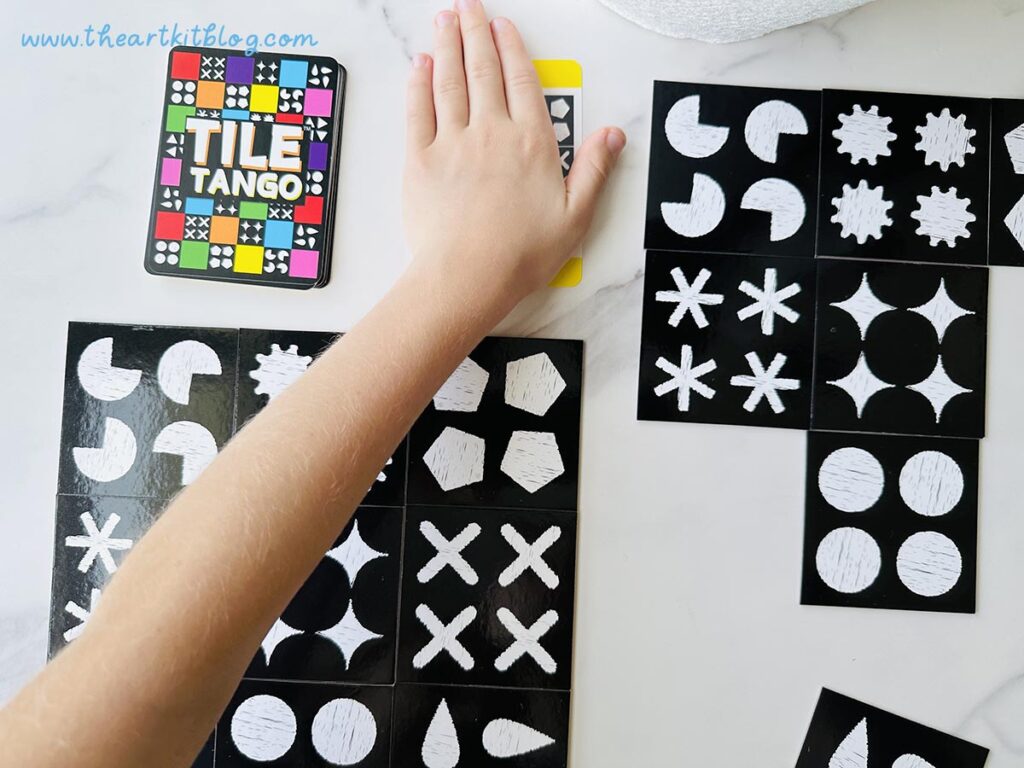
Tile Tango is a race to recreate colorful 3×3 patterns. Each player receives nine double-sided tiles. A match card is turned over to reveal a target design, and everyone works at the same time to arrange their tiles so that they look exactly like the card.
The first player to complete the pattern slaps the match card. If the arrangement is correct, that player claims the card and earns its points.
It sounds simple—and the first few patterns may feel simple—but the challenge grows as the designs become more detailed. A tile may have the right color but the wrong orientation, or the pattern may look correct until someone notices one tiny square hiding in the wrong corner. Tile Tango has that wonderful “Wait, I almost have it!” quality that makes everyone want to try one more card.
How to Play Tile Tango
Tile Tango is refreshingly easy to learn:
- Give each player a set of nine double-sided tiles.
- Flip over one match card to reveal the 3×3 target pattern.
- Everyone flips, turns, and moves their tiles to copy the pattern.
- The first player who finishes slaps the match card.
- Check the player's design. If it matches, that player keeps the card and earns the points shown by its difficulty.
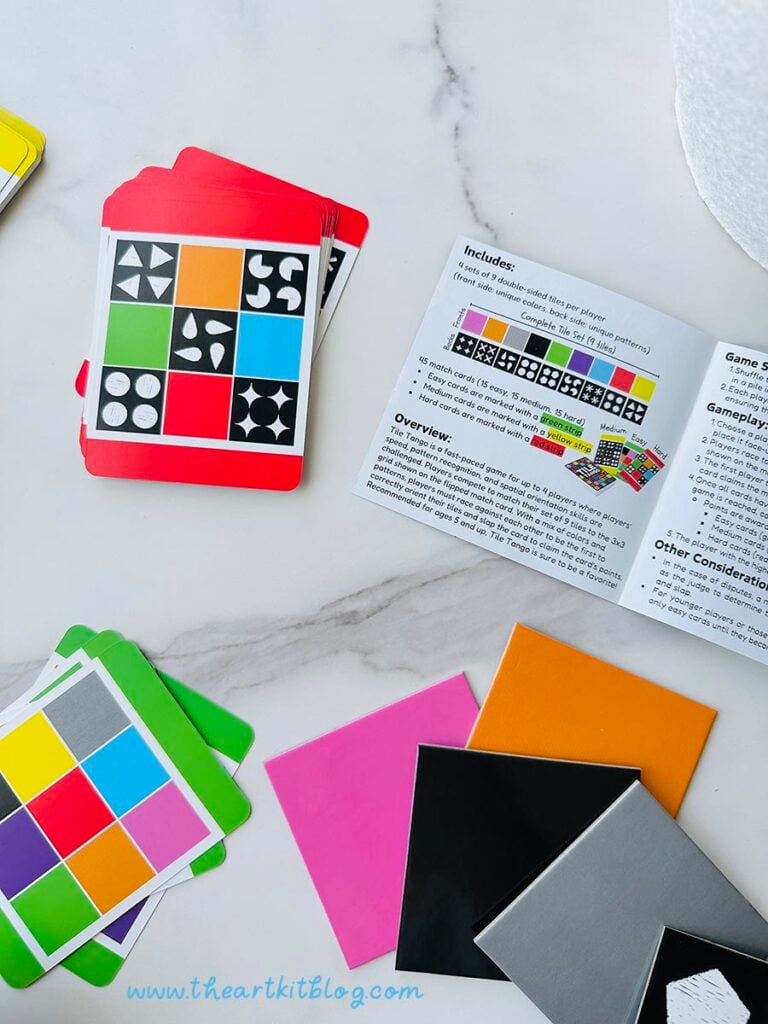
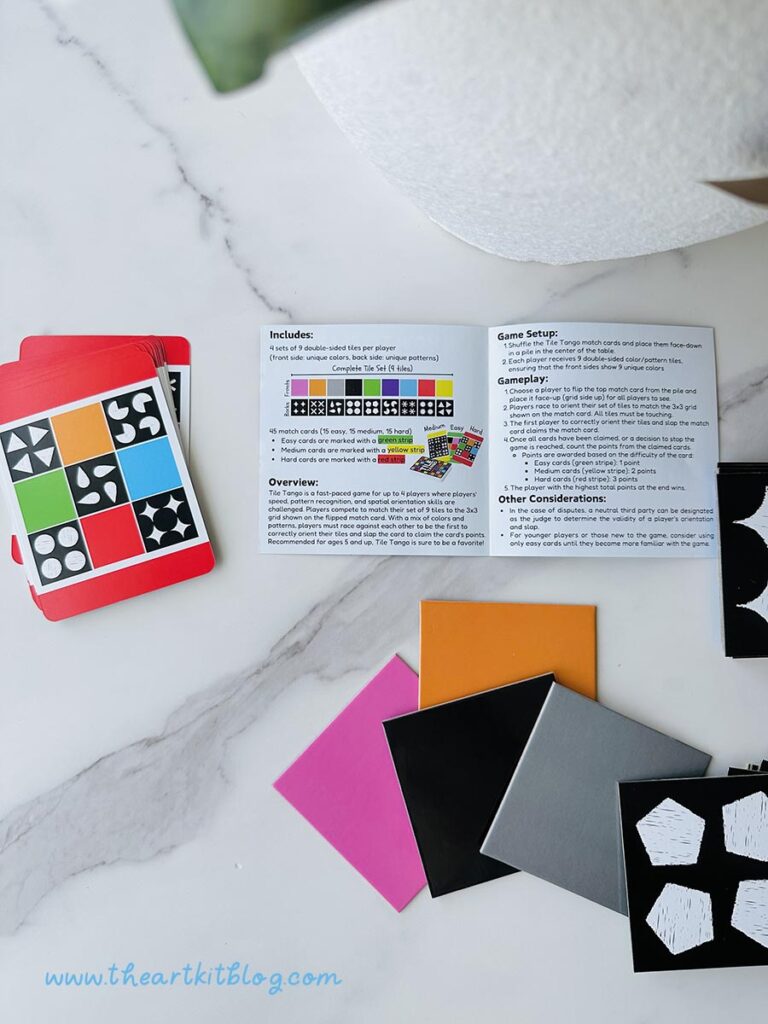
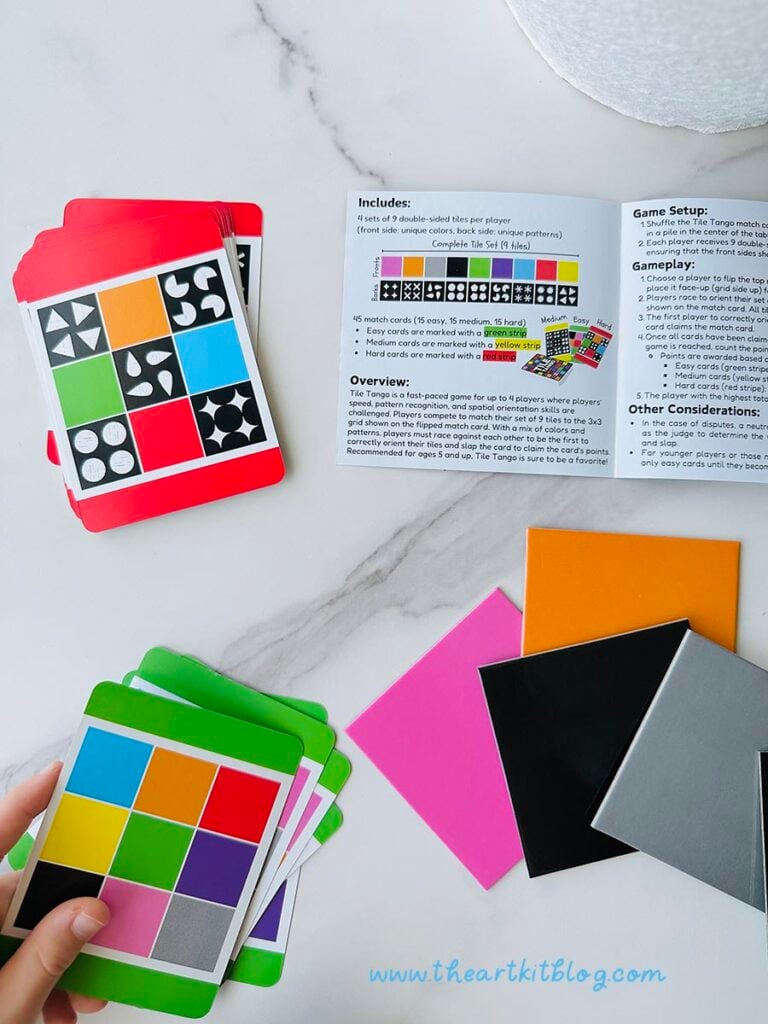
The cards use three difficulty levels:
- Green-striped cards are easy and worth one point.
- Yellow-striped cards are medium and worth two points.
- Red-striped cards are hard and worth three points.
You can play through all 45 cards, but you do not have to. Families can decide in advance to play a certain number of rounds, stop when someone reaches a chosen score, or simply play until attention spans begin packing their tiny suitcases.
What Makes Tile Tango Different?
There are plenty of matching games for kids, but Tile Tango is more active than a traditional memory game. Players are not waiting for individual turns or searching for two identical cards. Everyone is solving the same challenge simultaneously with their own set of tiles.
That creates a fun mixture of puzzle solving and friendly competition. Players must look carefully, make quick decisions, and adjust their tiles when something does not fit. Because the patterns change every round, the game does not depend on memorizing one solution.
The three difficulty levels are another helpful feature. Younger players can begin with the green cards while older children and adults tackle the more complex designs. Families can also remove the race element and let a child solve a card independently, which turns Tile Tango into a quiet visual-spatial activity.
A Game That Sneaks in Useful Skills
Tile Tango feels like a game—not a worksheet in a fake mustache—but it gives children practice with several useful thinking skills.
Pattern recognition
Children compare colors, positions, and arrangements as they recreate each design. They must notice both the individual tile details and how the complete pattern fits together.
Spatial reasoning
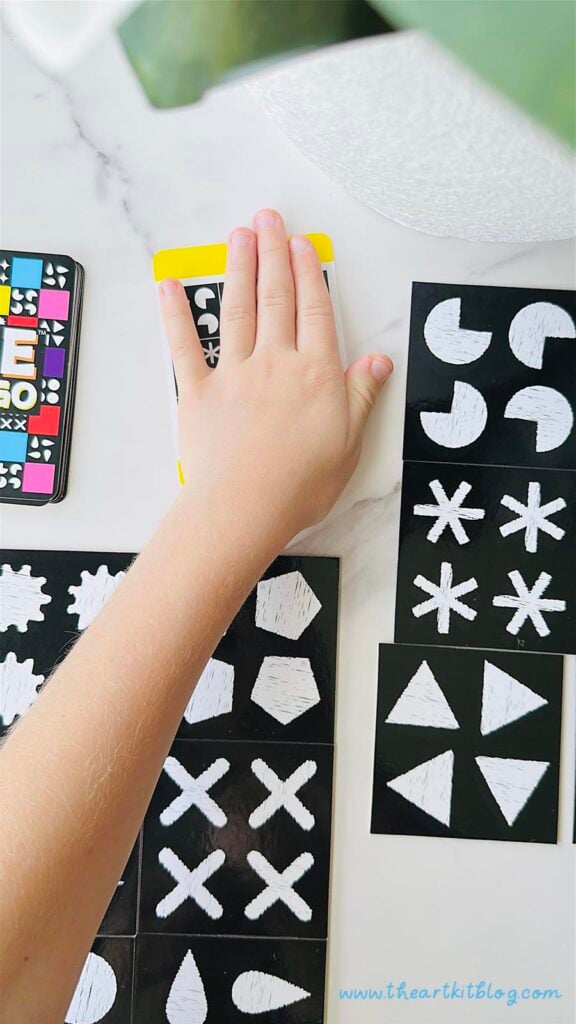
Players decide where each tile belongs and whether it needs to be flipped or repositioned. This encourages them to think about orientation, location, and how smaller pieces form a larger image.
Focus and visual attention
A nearly correct design is still not an exact match. Players have to scan the pattern carefully and catch small differences before slapping the card.
Flexible problem-solving
When the final tile does not fit, a player must reconsider the whole arrangement instead of forcing it into place. That quick “What needs to move?” moment is part of the challenge.
Processing speed
The racing format encourages players to take in visual information and respond quickly. For children who dislike timed activities, the game can easily be played cooperatively or without a speed requirement.
Is Tile Tango Good for Homeschooling?
Tile Tango would fit especially well in a homeschool game basket. It is educational without requiring lesson preparation, pencils, or another stack of papers to grade.
You could use it as:
- a morning basket activity;
- a brain break between subjects;
- a visual-spatial activity during math time;
- a quiet independent challenge using one tile set;
- a sibling game while working one-on-one with another child;
- or a screen-free travel activity.
It can also be adapted for mixed ages. Let younger children solve easier cards without racing, pair a younger child with an older sibling, or have everyone work together to complete a selected number of patterns.
What We Like About Tile Tango
The best thing about Tile Tango is how quickly the fun begins. The goal is clear, the pieces are hands-on, and players do not need to sit through a long explanation before the first round.
We also like that:
- everyone plays at the same time;
- the difficulty can grow with the players;
- rounds are short and easy to repeat;
- the tiles are thick enough for repeated handling;
- the compact box is easier to store or pack than a large board game;
- and the game works as either a competitive race or an untimed puzzle.
It is also satisfying in a very specific way. Finishing a pattern makes you feel clever for approximately three seconds—right up until someone flips the next card and your tiles seem to forget everything they know.
Things to Consider Before Buying
Tile Tango is built around speed and visual pattern matching, so it will naturally appeal most to children who enjoy puzzles, races, or hands-on challenges.
Younger children may need help learning to check the entire pattern before declaring that they are finished. Players who become frustrated by timed competition may prefer the cooperative or untimed version. Thankfully, the basic game is flexible enough to make those adjustments without changing the pieces or buying anything extra.
Because the game includes multiple small tiles, it is best played on a flat surface where every player has enough room to build a 3×3 grid.
Who Would Enjoy Tile Tango?
Tile Tango may be a particularly good fit for:
- families looking for a quick screen-free game;
- children who enjoy tangrams, puzzles, matching, or building challenges;
- homeschoolers who want learning games that do not feel like schoolwork;
- mixed-age siblings who need simple rules but adjustable difficulty;
- and families looking for a compact game for trips.
Although the recommended age begins at five, older children and adults can still enjoy racing through the harder cards. Speed has a funny way of making even a simple-looking pattern surprisingly challenging.
Our Final Tile Tango Thoughts
Tile Tango is simple to learn, quick to play, and different enough to stand out from the usual stack of children's matching games. The simultaneous play keeps everyone involved, while the escalating patterns add enough challenge to make repeat rounds worthwhile.
We especially like that the game can be played in several ways. Race for points during family game night, remove the timer pressure for a younger child, or use the cards as independent visual-spatial puzzles. That flexibility makes it useful for families with different ages and personalities.
If your children enjoy colorful puzzles, fast matching games, or hands-on brain challenges, Tile Tango is worth a look. It offers a lively bit of friendly competition while practicing focus, pattern recognition, and spatial reasoning—and no screen has to referee the chaos.
Frequently Asked Questions About Tile Tango
What age is Tile Tango for?
Tile Tango is recommended for ages five and up. Younger players may do best beginning with the easy cards or playing without the racing element.
How many people can play Tile Tango?
Tile Tango is designed for two to four players. A child can also use one tile set and the match cards as a solo puzzle activity.
How many cards are included in Tile Tango?
The game includes 45 match cards divided among three difficulty levels: easy, medium, and hard.
What skills does Tile Tango practice?
The game encourages pattern recognition, spatial reasoning, focus, visual attention, flexible problem-solving, and quick processing.
Is Tile Tango a good travel game?
The packaged game measures approximately 4.25 × 4.25 × 3.08 inches, making it compact enough to pack for many trips. Since players arrange loose tiles, it works best at a table or on another stable, flat surface.
Can Tile Tango be played without racing?
Yes. Players can solve the cards one at a time, work cooperatively, or complete patterns without a time limit. This is a useful option for younger children or anyone who does not enjoy speed-based play.
Discover More Fun Games Here:
- Squzzle Puzzle Review: The Screen-Free Brain Teaser You’ll Want to Solve Again and Again
- Prime Suspect: At the Ski Resort Review | A Fun Logic Game for Kids, Teens, and Adults
- Flipingo Review: A Fun Word Recognition and Vocabulary Bingo Game